

What Is A Vowel Suffix
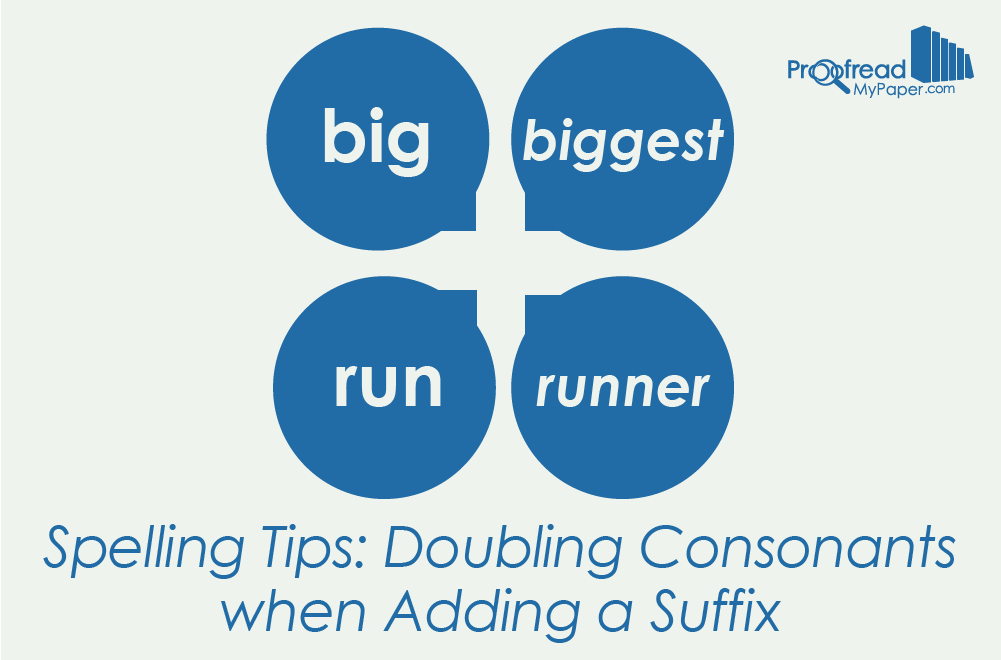
Spelling Tips: Doubling Consonants when Adding a Suffix
The "doubling upwardly" rule (or the "1:1:1 rule") is one of the few rules in English language spelling that is correct most of the time. Given how confusing English language tin can be, nosotros notice this reliability oddly comforting. Allow's expect at how it works.
What Is the Doubling Upward Rule?
The doubling up rule states that, when adding a vowel suffix (eastward.g., "-ing" or "-ed") to a unmarried-syllable word that ends with one vowel followed by ane consonant, we should double the final consonant. For instance, "dig" gains an extra "g" when changed to "digging." Boosted examples include:
| Base Discussion (Single Consonant) | With Vowel Suffix (Double Consonant) |
| Star | Starring, Starred, Starry |
| Run | Running, Runner |
| Big | Biggest, Bigger |
As you can see with "starry" (i.east., lit past stars), "y" is sometimes treated every bit a vowel for this dominion. Other words like this include "sunny," "blurry," and "furry."
The Exceptions
The only universal spelling dominion in English is that there's really no universal spelling rule in English. As such, we need to mention a few exceptions: words that end in "w," "x" or "y." These letters aren't usually doubled in English, so single-syllable words that end in a vowel plus "w," "x" or "y" don't crave doubling the final letter when adding a vowel suffix:
| Base Word (Single Consonant) | With Vowel Suffix (Double Consonant) |
| Play | Playing, Player, Played |
| Snow | Snowing, Snodue westiest, Snowestwarded |
| Box | Botening, Boxer, Boxed |
Multi-Syllable Words
Things get trickier with words more than i syllable long. Some even so crave doubling the last consonant when calculation a vowel suffix, such as:
| Base of operations Word (Unmarried Consonant) | With Vowel Suffix (Double Consonant) |
| Begin | Beginning, Beginner |
| Regret | Regretting, Regretted |
| Control | Controlling, Controlled, Controller |
These are generally words where the terminal syllable is stressed.
Find this useful?
Subscribe to our newsletter and become writing tips from our editors directly to your inbox.
When the last syllable of a multi-syllable word is not stressed, all the same, the concluding consonant is non usually doubled. Examples include:
| Base Word (Single Consonant) | With Vowel Suffix (Single Consonant) |
| Openorthward | Opening, Opened |
| Listen | Listening, Listened, Listener |
| Happenorthward | Happening, Happened |
In some cases, whether to double the final consonant depends on the suffix added. "Prefer," for instance, gains an extra "r" in "preferred" or "preferring." This is because, in both, the final syllable is stressed. Yet, no doubling is required in "preference," since the concluding syllable hither is unstressed.
Multi-Syllable Exceptions
There are some words that don't follow the pattern above, but with which we all the same double the final letter of the alphabet when adding a vowel suffix to clarify the pronunciation.
With "format," for instance, we typically place the stress on the first syllable. Just we all the same double the "t" when adding a suffix to bear witness that it is pronounced with a short vowel sound. Thus, we pronounce "formatted" as "for-mat-ed," not "for-mate-ed," and the double "t" before the suffix helps to analyze this.
In that location are besides some words that finish in an "-fifty" that are conventionally spelled with a single consonant in American English, simply that take a double consonant in British or Canadian English language. For instance:
| Base of operations Word | American English (Single Consonant) | British/Canadian English (Double Consonant) |
| Trave50 | Traveled, Traveling, Traveler | Travelled, Travelling, Traveller |
| Cancel | Canceled, Canceling | Cancelled, Cancelling |
| Mannerl | Modeled, Wayling, Modeler | Mannerlled, Modelling, Modeller |
In other words, multi-syllable words can exist tricky! Using the pronunciation to guide your spelling will usually assistance, but don't forget to cheque specific words in a lexicon if you're unsure whether to double the terminal consonant when adding a vowel suffix. Likewise, information technology'due south of import to proofread your work carefully and double check any words that you're not 100% sure are spelled correctly.

What Is A Vowel Suffix,
Source: https://proofed.com/writing-tips/spelling-doubling-consonants-adding-suffix/
Posted by: hawkinsmortard.blogspot.com
0 Response to "What Is A Vowel Suffix"
Post a Comment