

Coming Of Age Day Korea
| Victory over Japan Day | |
|---|---|
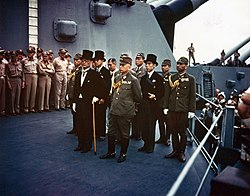 Representatives of the Empire of Japan aboard USSMissouri at the surrender of Japan on 2 September 1945 | |
| As well called | V-J Day, Victory in the Pacific Mean solar day, V-P Day |
| Date | 2 September 1945 |
| Frequency | Annually |
| Related to | Victory in Europe Mean solar day |
Victory over Nippon Twenty-four hours (besides known as 5-J Day, Victory in the Pacific Day, or V-P Day [1]) is the mean solar day on which Royal Japan surrendered in World State of war Two, in effect bringing the state of war to an end. The term has been practical to both of the days on which the initial proclamation of Japan'southward surrender was made – fifteen August 1945, in Japan, and because of time zone differences, 14 August 1945 (when it was announced in the United States and the rest of the Americas and Eastern Pacific Islands) – as well as to 2 September 1945, when the surrender document was signed, officially ending World War II.
15 August is the official V-J Day for the United Kingdom, while the official U.s.a. commemoration is 2 September.[ii] The proper name, V-J Day, had been selected by the Allies later they named V-East Twenty-four hour period for the victory in Europe.
On 2 September 1945, formal surrender occurred aboard the battleship USS Missouri in Tokyo Bay. In Japan, fifteen Baronial usually is known equally the "memorial day for the end of the war" ( 終戦記念日 , Shūsen-kinenbi ) ; the official name for the twenty-four hours, even so, is "the day for mourning of war dead and praying for peace" ( 戦没者を追悼し平和を祈念する日 , Senbotsusha o tsuitōshi heiwa o kinensuru hello ) . This official proper name was adopted in 1982 by an ordinance issued by the Japanese regime.[three]
Give up [edit]
Events before 5-J Day [edit]
On August 6 and 9, 1945, the Allies dropped atomic bombs on Hiroshima and Nagasaki, respectively. On Baronial nine, the Soviet Union declared war on Japan. The Japanese government on August 10 communicated its intention to surrender under the terms of the Potsdam Annunciation.
The news of the Japanese offer began early on celebrations around the world. Allied soldiers in London danced in a conga line on Regent Street. Americans and Frenchmen in Paris paraded on the Champs-Élysées singing "Don't Fence Me In". American soldiers in occupied Berlin shouted "It's over in the Pacific", and hoped that they would now not be transferred in that location to fight the Japanese. Germans stated that the Japanese were wise enough to—unlike themselves—surrender in a hopeless situation, and were grateful that the atomic flop was not ready in time to exist used against them. Moscow newspapers briefly reported on the diminutive bombings with no commentary of any kind. While "Russians and foreigners akin could hardly talk nearly anything else", the Soviet government refused to make any statements on the bombs' implication for politics or science.[4]
In Chungking, Chinese fired firecrackers and "almost buried [Americans] in gratitude". In Manila, residents sang "God Bless America". On Okinawa, half-dozen men were killed and dozens were wounded as American soldiers "took every weapon inside achieve and started firing into the sky" to celebrate; ships sounded general quarters and fired anti-shipping guns equally their crews believed that a kamikaze assault was occurring. On Tinian island, B-29 crews preparing for their side by side mission over Nippon were told that it was cancelled, just that they could not celebrate considering it might be rescheduled.[iv]
Nihon's acceptance of the Potsdam Declaration [edit]
A little subsequently noon Japan Standard Time on Baronial 15, 1945, Emperor Hirohito's proclamation of Nippon'southward credence of the terms of the Potsdam Announcement was broadcast to the Japanese people over the radio. Before the same day, the Japanese government had circulate an annunciation over Radio Tokyo that "acceptance of the Potsdam Proclamation [would be] coming soon", and had advised the Allies of the surrender by sending a cable to U.S. President Harry Southward Truman via the Swiss diplomatic mission in Washington, D.C.[five] A nationwide broadcast by Truman was aired at seven o'clock p.m. (daylight time in Washington, D.C.) on Tuesday, Baronial xiv, announcing the communication and that the formal event was scheduled for September two. In his declaration of Japan's surrender on August 14, Truman said that "the announcement of 5-J Twenty-four hours must wait upon the formal signing of the surrender terms by Japan".[half dozen]
Since the European Axis Powers had surrendered three months earlier (5-East Solar day), V-J Mean solar day was the constructive end of World War II, although a peace treaty between Japan and near of the Allies was not signed until 1952, and between Japan and the Soviet Wedlock until 1956. In Australia, the proper name V-P Day (Victory in the Pacific) was used from the outset. The Canberra Times of August 14, 1945, refers to V-P Twenty-four hour period celebrations, and a public holiday for V-P Day was gazetted by the authorities in that year according to the Australian War Memorial.[vii] [i]
Public celebrations [edit]
After news of the Japanese credence and earlier Truman's announcement, civilians began celebrating "as if joy had been rationed and saved up for the three years, eight months and seven days since Sunday, Dec. vii, 1941" (the mean solar day of the Japanese attack on Pearl Harbor), Life magazine reported.[viii] In Washington, D.C. a crowd attempted to break into the White Business firm grounds as they shouted "We want Harry!"[9]
In San Francisco two nude women jumped into a swimming at the Borough Centre to soldiers' thanks.[8] More seriously, thousands of drunken people, the vast majority of them Navy enlistees who had non served in the war theatre, embarked in what the San Francisco Chronicle summarized in 2015 as "a 3-nighttime orgy of vandalism, looting, set on, robbery, rape and murder" and "the deadliest riots in the city's history", with more than 1,000 people injured, xiii killed, and at least six women raped. None of these acts resulted in serious criminal charges, and no civilian or military official was sanctioned, leading the Chronicle to conclude that "the metropolis simply tried to pretend the riots never happened".[10]
The largest crowd in the history of New York City's Times Square gathered to celebrate.[8] The victory itself was announced by a headline on the "attachment" news ticker at One Times Square, which read "OFFICIAL *** TRUMAN ANNOUNCES JAPANESE Give up ***"; the vi asterisks represented the branches of the U.South. Armed Forces.[11] In the Garment District, workers threw out cloth scraps and ticker tape, leaving a pile five inches deep on the streets. The news of the war's end sparked a "coast-to-coast frenzy of [servicemen] kissing . . . everyone in skirts that happened along," with Life publishing photographs of such kisses in Washington, Kansas Metropolis, Los Angeles, and Miami.[8]
-
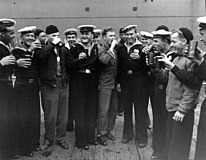
Usa and Soviet sailors and seamen celebrating together V-J Day on August 14, 1945
-

Crowds celebrating V-J Day in Times Square on August 14, 1945
-

Allied military personnel in Paris jubilant V-J Day on August 15, 1945
-

Crowds in Shanghai jubilant V-J Day on August 15, 1945
-

Chinese victory parade in Chungking on September 3, 1945
-

Montreal'southward Chinese community celebrates V-J Day with a parade in Chinatown on September two, 1945
-

Civilians and service personnel in London celebrating 5-J Day on August 15, 1945
Famous photographs [edit]

Ane of the best-known kisses that day appeared in V-J Day in Times Foursquare, one of the most famous photographs e'er published past Life. It was shot on August fourteen, 1945, shortly afterward the announcement past President Truman occurred and people began to gather in celebration. Alfred Eisenstaedt went to Times Square to take candid photographs and spotted a sailor who "grabbed something in white. And I stood there, and they kissed. And I snapped 4 times."[12] The aforementioned moment was captured in a very like photo by Navy photographer Victor Jorgensen (correct), published in the New York Times.[xiii] Several people have since claimed to be the sailor or the female, who was long causeless to be a nurse.[14] It has since been established that the woman in the Alfred Eisenstaedt photograph was actually a dental banana named Greta Zimmer Friedman, who clarified in a after interview that "information technology wasn't my choice to be kissed. The guy simply came over and kissed or grabbed.".[15]
Another famous photograph is that of the Dancing Homo in Elizabeth Street, Sydney, captured by a press photographer and a Movietone newsreel. The moving-picture show and stills from it have taken on iconic status in Australian history and culture every bit a symbol of victory in the war.
Japanese reaction [edit]
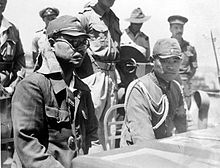
Japanese commanders listen to the terms of surrender aboard an Australian warship.
On Baronial 15 and sixteen, some Japanese soldiers, devastated by the surrender, committed suicide. Well over 100 American prisoners of war were also murdered. In addition, many Australian and British prisoners of war were murdered in Borneo, at both Ranau and Sandakan, past the Regal Japanese Ground forces.[xvi] At Batu Lintang camp, as well in Borneo, death orders were found which proposed the murder of some 2,000 POWs and civilian internees on September 15, 1945, just the camp was liberated four days earlier these orders were due to be carried out.[17] Japanese forces remained in combat with Soviet forces on several fronts for two weeks post-obit VJ-Mean solar day.
Ceremony aboard USS Missouri [edit]
The formal signing of the Japanese Musical instrument of Surrender took place on lath the battleship USSMissouri in Tokyo Bay on September 2, 1945, and at that time Truman alleged September two to exist the official V-J Twenty-four hours.[18]
Chronology [edit]
- April 1 – June 21, 1945: Battle of Okinawa. 82,000+ US military casualties, and 117,000+ Japanese and Okinawan. Approximately ane-fourth of the Okinawan noncombatant population died, often in mass suicides organized by the Imperial Japanese Army.
- July 26: The Potsdam Annunciation is issued. Truman tells Japan, "Surrender or endure prompt and utter devastation."[19]
- July 29: Nihon rejects the Potsdam Annunciation.
- August 2: The Potsdam Conference ends.
- Baronial 6: The US drops an atomic bomb, Little Boy, on Hiroshima. In a press release 16 hours afterwards, Truman warns Nihon to give up or "wait a rain of ruin from the air, the similar of which has never been seen on this earth."[20]
- August 9: The USSR declares war on Japan, and invades several Japanese-held territories. The US drops another atomic bomb, Fat Homo, on Nagasaki.
- Baronial ten: At the direction of the Emperor, the Japanese Foreign Ministry notifies the Allies (via Swiss diplomatic channels) of Japan's intention to surrender unconditionally in accordance with the terms of the Potsdam Declaration, providing the Emperor be permitted to remain in place.
- August 11: The Allies notify the Japanese authorities (again via Swiss diplomats) of their willingness to have Japan's surrender as offered.
- Baronial fourteen: Allied governments announce the give up of Japan, and the Emperor informs his people of the fact in an unprecedented radio broadcast. The date is described equally "V-J Day" or "V-P Day" in newspapers in the United states, Uk, Australia, New Zealand, and Canada.
- September 2: Official surrender anniversary is held aboard USSMissouri in Tokyo Bay; President Truman declares September 2 equally the official "V-J Twenty-four hour period".
- November i: Scheduled offset of Operation Olympic, the planned Allied invasion of Kyushu.
- March 1, 1946: Scheduled commencement of Operation Coronet, the planned Allied invasion of Honshu.
- September viii, 1951: 48 countries including Nihon and nigh of the Allies sign the Treaty of San Francisco
- April 28, 1952: The Treaty of San Francisco goes into effect, formally ending the country of war betwixt Japan and most of the Allied countries.
Post war:
- Some Japanese soldiers continued to fight on isolated Pacific islands until at to the lowest degree the 1970s, with the terminal known Japanese soldier surrendering in 1974.[21] [22] [23] [24]
Commemoration [edit]
Australia [edit]

Victory celebrations at Caloundra, Queensland 1945
In Australia, many use the term "VP 24-hour interval" in preference to "VJ Day", only in the publication The Sixth Yr of War in Pictures published by The Sunday News-Pictorial in 1946, the term "VJ Twenty-four hour period" is used on pages 250 and 251.[25] As well an Australian Regime 50th Anniversary Medal issued in 1995 has "VJ-24-hour interval" stamped on information technology.[26]
Apprentice radio [edit]
Apprentice radio operators in Australia hold the "Remembrance Day Competition" on the weekend nearest VP Solar day, August 15, remembering apprentice radio operators who died during Globe War II and to encourage friendly participation and aid improve the operating skills of participants. The contest runs for 24 hours, from 0800 UTC on the Saturday, preceded by a broadcast including a speech by a dignitary or notable Australian (such as the Prime Minister of Australia, Governor-General of Commonwealth of australia, or a military leader) and the reading of the names of apprentice radio operators who are known to have died. Information technology is organized by the Wireless Institute of Australia, with operators in each Australian state contacting operators in other states, New Zealand, and Papua New Guinea. A trophy is awarded to the state that can avowal the greatest rate of participation, based on a formula including: number of operators, number of contacts made, and radio frequency bands used.[27]
China [edit]

As the final official surrender of Nippon was accustomed aboard the battleship USS Missouri in Tokyo Bay on September 2, 1945, the Nationalist Government of the Republic of Red china, which represented Cathay on the Missouri, announced three-day holidays to celebrate 5-J Twenty-four hour period, starting September 3. Starting from 1946, September 3 was historic every bit "Victory of State of war of Resistance confronting Japan Day" (Chinese: 抗日戰爭勝利紀念日; pinyin: Kàngrì Zhànzhēng Shènglì Jìniànrì ), which evolved into the Armed forces Mean solar day (Chinese: 軍人節) in 1955. September 3 is recognized as V-J 24-hour interval in mainland China.[ commendation needed ]
Hong Kong [edit]
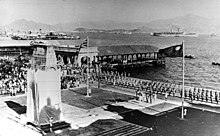
Hong Kong was handed over by the Purple Japanese Army to the Purple Navy on Baronial 30, 1945, and resumed its pre-war status as a British dependency. Hong Kong celebrated the "Liberation Day" (Chinese: 重光紀念日; Jyutping: cung4 gwong1 gei2 nim3 jat6 ) on Baronial 30 (later moved to the Saturday preceding the concluding Mon in August) annually, which was a public holiday before 1997. Afterwards the transfer of sovereignty in 1997, the celebration was moved to the third Mon in August and renamed "Sino-Japanese War Victory Day", the Chinese name of which is literally "Victory of War of Resistance against Japan Mean solar day" as in the rest of China, only this day was removed from the list of public holidays in 1999. In 2014, the Chief Executive's Function announced that a commemoration ceremony would be held on September 3, in line with the "Victory Day of the Chinese people'southward war of resistance against Japanese aggression" in mainland China.[28]
Korea [edit]
Gwangbokjeol, (significant "the day the calorie-free returned") celebrated annually on August fifteen, is a public holiday in Republic of korea. Information technology commemorates Victory over Japan Day, which liberated Korea from Japanese dominion.[29] The day is also celebrated as a public vacation, Liberation Day, in North Korea, and is the only public vacation celebrated in both Koreas.
Mongolia [edit]

Victory over Japan Day is celebrated with duality in Mongolia. Information technology also celebrates the victory of Soviet and Mongolian forces in the Battles of Khalkhin Gol. The anniversary of the boxing was first celebrated in 1969, and was periodically celebrated on a massive calibration every 5 years until its 50th anniversary in 1989, afterward which information technology dwindled in importance and was reduced to the level of academic debates and lectures. It was merely recently that the anniversary fabricated a resurgence in Mongolian history.[30] It is jointly celebrated by the Mongolian Armed Forces with the Russian Armed Forces. During the 70th, 75th and 80th anniversaries in 2009, 2014 and 2019 respectively, the President of Russia has taken part in the celebrations aslope the President of Mongolia equally part of the quondam'south state visit to the Mongolian capital.
Netherlands [edit]

Kingdom of the netherlands has one national and several regional or local remembrance services on or around Baronial 15. The national service is at the "Indisch monument" (Dutch for "Indies Monument") in The Hague, where the victims of the Japanese occupation of the Dutch East Indies are remembered, usually in the presence of the head of country and the government. In total, there are near 20 services, also in the Indies remembrance center in Bronbeek in Arnhem. The Japanese occupation meant the twilight of Dutch colonial rule over Indonesia. Indonesia declared itself independent on August 17, 1945, just ii days after the Japanese surrendered. The Indonesian State of war of Independence lasted until 1949, with the netherlands recognizing Indonesian sovereignty in late December of that yr.
Vietnam [edit]
On the twenty-four hours of the surrender of Japan, Hồ Chí Minh declared an independent Democratic Democracy of Vietnam.[31]
Vietnam celebrated xix August as Five-J Day, because of the victory of August Revolution against the Japanese forces.
Philippines [edit]
In the Philippines, V-J Day is celebrated annually on September iii and is called the "Surrender of General Tomoyuki Yamashita Day".[32] The province of Ifugao has observed every September 2 as "Victory Day", commemorating the valor of Philippine war veterans and the breezy surrender of General Yamashita to the articulation Filipino-American troops led-by Cpt. Grisham in the municipality of Kiangan on September ii, 1945.[33] [34]
Russia/Former USSR [edit]
Information technology was introduced equally a holiday past decree of the Presidium of the Supreme Soviet of the Soviet Union on September 3, 1945 (the solar day later the surrender of Nippon). The only celebration that was held in the days that followed was a parade of the Reddish Army in Harbin. In 1945 and 1946, this twenty-four hour period was a national holiday. In subsequent years, it became a working day and no celebrations were held on this occasion. In modern Russia, Victory over Japan Day (Russian: День победы над Японией) is considered a memorable engagement and is celebrated every bit one of many Days of Armed services Honour. In recent years such every bit in 2017,[35] bills in the State Duma have proposed making it a national vacation.[36] [37]
A war machine parade of the Eastern Military District is annually held in the cities of Yuzhno-Sakhalinsk or Khabarovsk, being one of the only parades being held on this twenty-four hour period. Parades have also been held on September 2 in the federal subjects of Russian federation that celebrate the anniversary of the Battles of Khalkhin Gol, such as Buryatia, Yakutia and the Altai Republic.[38] [39] In the breakaway Moldovan-democracy of Transnistria, Victory over Japan Solar day is jointly historic with their Republic Day celebrations, which take identify on the same twenty-four hours.[forty]
United States [edit]
Although September two is the designated "5-J Day" in the entire United States, the event is not an official federal or state holiday. Rhode Island celebrates the ending of WW2 equally "Victory Mean solar day",[41] and it is observed on the 2d Monday of August.
5-J Twenty-four hours was initially commemorated throughout the Us every twelvemonth on September 2, showtime in 1948, simply as the war faded from memory so has the holiday. Co-ordinate to WPRI-Television set, the reason for abolishing V-J Mean solar day was economic, because workers got a paid twenty-four hour period off. In that location was even a argue over whether or not even Rhode Island would abolish their own Victory Day celebrations. Some towns in various states still gloat 5-J twenty-four hours. Moosup, Connecticut holds an annual V-J 24-hour interval parade on the 2nd Sunday in August, and holds the distinction of being the oldest continuous parade jubilant V-J twenty-four hour period since the actual surrender of the Japanese in 1945. Arkansas was the only other state to make the vacation official statewide, but it abolished it in 1975, leaving Rhode Isle every bit the only remaining land.[42]
World Peace 24-hour interval [edit]
Information technology was suggested in the 1960s to declare September 2, the ceremony of the terminate of World State of war II, every bit an international vacation to be called World Peace Mean solar day. However, when this holiday came to be start historic beginning in 1981, it was designated as September 21, the mean solar day the General Assembly of the United Nations begins its deliberations each year.
Meet also [edit]
- Japanese holdouts
- Mokusatsu
- Kyūjō incident
- Retrocession Day, in Taiwan (ROC)
- Stunde Zippo
- Robert Trout, offset American newsman to announce the Japanese surrender
Notes [edit]
- ^ Oak Ridge was office of the Manhattan Project, which resulted in the atomic bomb.
References [edit]
- ^ a b "Victory in the Pacific (VP) Day". Australian War Memorial. Archived from the original on xv Baronial 2019. Retrieved 15 Baronial 2019.
- ^ "History.com". Archived from the original on vii March 2010. Retrieved 14 Baronial 2010.
- ^ 厚生労働省:全国戦没者追悼式について (in Japanese). Ministry of Health, Labour and Welfare. 8 August 2007. Archived from the original on 21 March 2008. Retrieved 16 February 2008.
- ^ a b "Victory Reports Around the World: U. Due south. Fighting Men Atomic number 82 Wild Celebrations at Japs' Surrender Offer". Life. xx August 1945. pp. 38–38A. Archived from the original on 22 June 2013. Retrieved 25 November 2011.
- ^ Hakim, Joy (1995). A History of Us: War, Peace and all that Jazz. New York: Oxford University Press. ISBN0-19-509514-6.
- ^ "Japanese acceptance of Potsdam proclamation announced by President Truman". ibiblio.org. Archived from the original on 17 May 2017. Retrieved 21 May 2009.
- ^ "Canberra Times – Local Canberra News, World News & Breaking News in ACT, Australia". Archived from the original on 14 August 2016. Retrieved 15 August 2016.
- ^ a b c d "Victory Celebrations". Life. 27 August 1945. p. 21. Archived from the original on 21 June 2013. Retrieved 25 Nov 2011.
- ^ "Earth Enters Era of Peace equally Truman Warns of Job Ahead". Warren Times Mirror. Warren, PA. 15 August 1945. p. 1. Retrieved twenty August 2015 – via Newspapers.com.

- ^ Kamiya, Gary (14 Baronial 2015). "'Peace Riots' left trail of death at end of WWII in Southward.F." San Francisco Relate. Archived from the original on eighteen May 2017. Retrieved fourteen Baronial 2015.
- ^ Van Gelder, Lawrence (11 Dec 1994). "Lights Out for Times Square News Sign?". The New York Times. Archived from the original on 8 May 2016. Retrieved 20 January 2013.
- ^ Eisenstaedt, Alfred (1985). Eisenstaedt on Eisenstaedt. Abbeville Press.
- ^ Newman, Andy (thirteen August 2010). "Nurse Tells of Storied Buss. No, Not That Nurse". The New York Times. New York, NY. Archived from the original on 12 October 2015. Retrieved 24 Baronial 2015.
- ^ Chan, Sewell (14 August 2007). "62 Years Later, a Kiss That Tin't Be Forgotten". The New York Times. New York, NY. Archived from the original on v September 2015. Retrieved 24 August 2015.
- ^ "Interview Transcript: Greta Zimmer Friedman: Veterans History Project (Library of Congress".
- ^ Remembering Sandakan: 1945–1999 Archived July 14, 2009, at the Wayback Machine "Captain Hoshijima Susumi was able to reveal from his knowledge of the war crimes interrogation documents that the last POWs had been killed at Ranau on 27 August 1945, well after the Japanese give up. They had undoubtedly been killed, in Moffitt's view, to terminate them being able to bear witness to the atrocities committed by the guards."
- ^ Ooi, Keat Gin (1998) Japanese Empire in the Tropics: Selected Documents and Reports of the Japanese Catamenia in Sarawak, Northwest Kalimantan, 1941–1945 Ohio University Centre for International Studies, Monographs in International Studies, SE Asia Serial 101 (2 vols), page 648; Keith, Agnes, 1947 Three Came Home183, 206
- ^ "Public Papers". Truman Library. i September 1945. Archived from the original on 11 Feb 2012. Retrieved 28 February 2012.
- ^ "Potsdam Declaration: Declaration Defining Terms for Japanese Surrender Issued, at Potsdam, July 26, 1945". National Science Digital Library. Archived from the original on 19 May 2017. Retrieved 16 Baronial 2015.
- ^ "PBS: Statement By The President". PBS. Archived from the original on 10 August 2015. Retrieved fifteen August 2015.
- ^ Kristof, Nicholas D. "Shoichi Yokoi, 82, Is Expressionless; Japan Soldier Hid 27 Years," Archived February one, 2009, at the Wayback Machine New York Times. September 26, 1997.
- ^ "The Concluding PCS for Lieutenant Onoda," Pacific Stars and Stripes, March 13, 1974, p6
- ^ "Onoda Home; 'It Was thirty Years on Duty'," Pacific Stars and Stripes, March 14, 1974, p7
- ^ "The Last Last Soldier?". Time.com. thirteen Jan 1975. Archived from the original on 22 May 2013. Retrieved 28 Feb 2012.
- ^ "The 6th Year of War in Pictures", The Sun News Pictorial, Melbourne. 1946
- ^ "Wartime Issue 21". Australian War Memorial . Retrieved 16 Baronial 2020.
- ^ "Remembrance Day Contest". Archived from the original on 22 May 2017. Retrieved xv August 2009.
- ^ "HK to mark China 'victory' over Japan". bangkokpost.com.
- ^ "What is Gwangbokjeol?". Archived from the original on 1 September 2017. Retrieved 1 September 2017.
- ^ "WHO LOSES IN KHALKHIN GOL BATTLE". world wide web.baabar.mn | Шилдэг нийтлэлчдийн клуб.
- ^ "Vietnam independence proclaimed". Archived from the original on 1 September 2017. Retrieved i September 2017.
- ^ "September three declared holiday nationwide to commemorate Yamashita surrender". Dominicus.Star Philippines. 19 February 2019. Archived from the original on two August 2019. Retrieved 2 August 2019.
- ^ "PVAO recognizes Ifugao town for promoting valor and heroism of veterans". Philippine Information Agency. Philippine Information Agency - Cordillera Administrative Region. ix December 2014. Archived from the original on ii January 2015. Retrieved 2 Baronial 2019.
- ^ "Re-enactment of WWII episodes steal show during Victory Day Celebration in Ifugao". Philippine Data Agency. 3 September 2012. Archived from the original on 21 August 2016. Retrieved 2 Baronial 2019.
- ^ "В России предлагают учредить День победы над Японией". РИА Новости. 31 October 2017. Retrieved 31 October 2017.
- ^ "День победы над милитаристской Японией - конец Второй Мировой Войны!". Праздник каждый день. redday.ru. Archived from the original on iii November 2017. Retrieved 31 October 2017.
- ^ "Подзабытое торжество". Новая газета. 26 March 2010. Retrieved 31 October 2017.
- ^ "Парад в честь lxxx-летия Победы советских и монгольских войск на реке Халхин-Гол прошел в Улан-Удэ". egov-buryatia.ru.
- ^ "Info". Regnum.ru. 16 September 2019. Retrieved 30 Dec 2019.
- ^ Парад в честь 73-й годовщины окончания Второй мировой войны прошёл в Южно-Сахалинске - SakhalinMedia
- ^ "Home > State Library > History of Rhode Island > State Facts & Figures". Rhode Isle Part of the Secretary of State. Archived from the original on 27 September 2013. Retrieved 24 September 2013.
- ^ "Information technology'southward Victory Twenty-four hour period, an only-in-Rhode Island institution since 1975". Archived from the original on 14 August 2013.
External links [edit]

Wikimedia Commons has media related to V-J Day.
- Original Certificate: Surrender of Japan
- The U.S. Army in Post-WWII Nihon
- V-J Day portal Archived May 22, 2017, at the Wayback Motorcar at the Us Army Center of Military History
- VJ Day in New Zealand
- RAW: Russia'due south Kamchatka commemorates 70th anniversary of victory in WWII
- Uk - 50th Anniversary Of VJ Day Festivities

Coming Of Age Day Korea,
Source: https://en.wikipedia.org/wiki/Victory_over_Japan_Day
Posted by: hawkinsmortard.blogspot.com
0 Response to "Coming Of Age Day Korea"
Post a Comment